
Net metering in Pakistan allows solar system owners to send excess electricity back to the national grid and receive bill credits in return. For households and businesses struggling with rising electricity costs, net metering has become one of the most searched solar topics in Pakistan—and for good reason. This guide explains what net metering is, how it works, who can apply, costs, timelines, common problems, and real-world outcomes, all in clear, simple English.
What Is Net Metering in Pakistan?
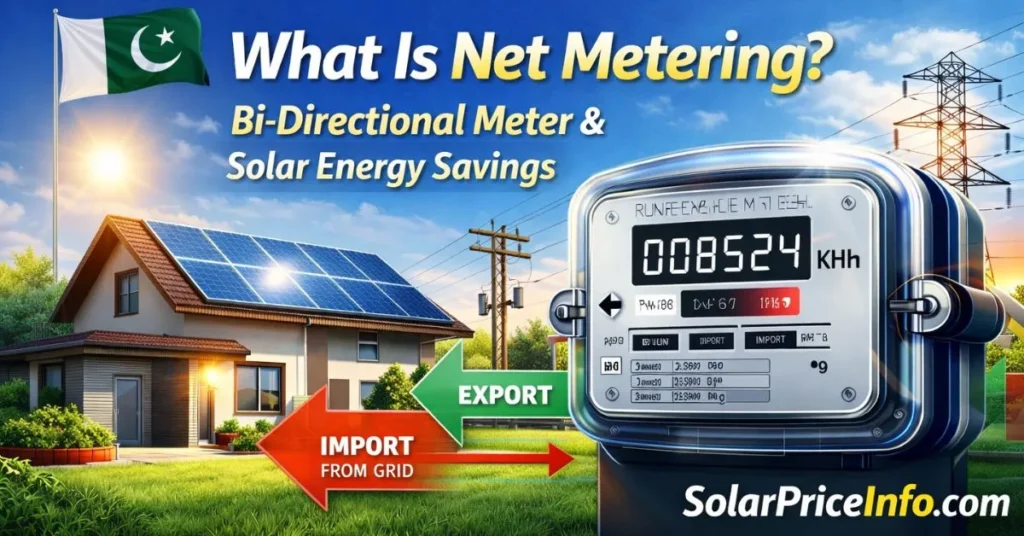
Net metering is a billing mechanism that connects your on-grid solar system to the utility grid through a bi-directional meter. When your solar panels generate more electricity than you consume, the surplus is exported to the grid. When you need power (at night or during low sunlight), you import electricity from the grid. At the end of the billing cycle, exported units are adjusted against imported units.
In simple terms, you use solar first, share extra power with the grid, and your bill is reduced through unit adjustment.
How Net Metering Works (Step by Step)
- Solar panels generate electricity during the day.
- Home/office uses solar power first.
- Extra units flow to the grid via a bi-directional meter.
- At night or during low production, electricity is drawn from the grid.
- The monthly bill adjusts exported units against imported units.
This system rewards efficient daytime production and reduces reliance on grid electricity.

Who Is Eligible for Net Metering in Pakistan?
Eligibility is governed by national regulations and implemented by local DISCOs. In general, you can apply if:
- You have a grid-connected (on-grid or hybrid in on-grid mode) solar system
- Your premises have a valid electricity connection
- Your system meets technical and safety standards
- You install a bi-directional meter approved by the utility
Further Reading: Solar System Sizing for Homes in Pakistan
Minimum System Requirement
While exact thresholds can vary by DISCO, small residential systems are commonly accepted, provided they meet technical criteria. Larger systems may face additional checks.
Net Metering Application Process
- Install an on-grid solar system through a qualified installer
- Prepare documents (CNIC, electricity bill, system details, wiring diagram)
- Submit your application to your DISCO
- Technical inspection by the utility team
- Meter installation & agreement
- Net metering activation
Tip: Incomplete documents and wiring non-compliance are the most common causes of delay.
Further Reading: solar inverter types for net metering
How Long Does Net Metering Approval Take?
Approval time depends on documentation quality and local workload. Typically:
- Inspection & review: a few weeks
- Meter installation: after approval
- Activation: once agreements are signed
Delays can occur due to inspection backlogs or missing technical details. Staying compliant from day one speeds things up.
Net Metering Costs in Pakistan (What to Expect)
Costs are not a single fixed number and depend on system size and utility requirements.
| Cost Component | What It Covers |
|---|---|
| Bi-directional meter | Approved import/export meter |
| Inspection & processing | Utility technical checks |
| Wiring & compliance | Safety upgrades if needed |
| Installer services | Documentation & coordination |
Important: Net metering reduces bills through unit adjustment; it does not usually pay cash for exports.
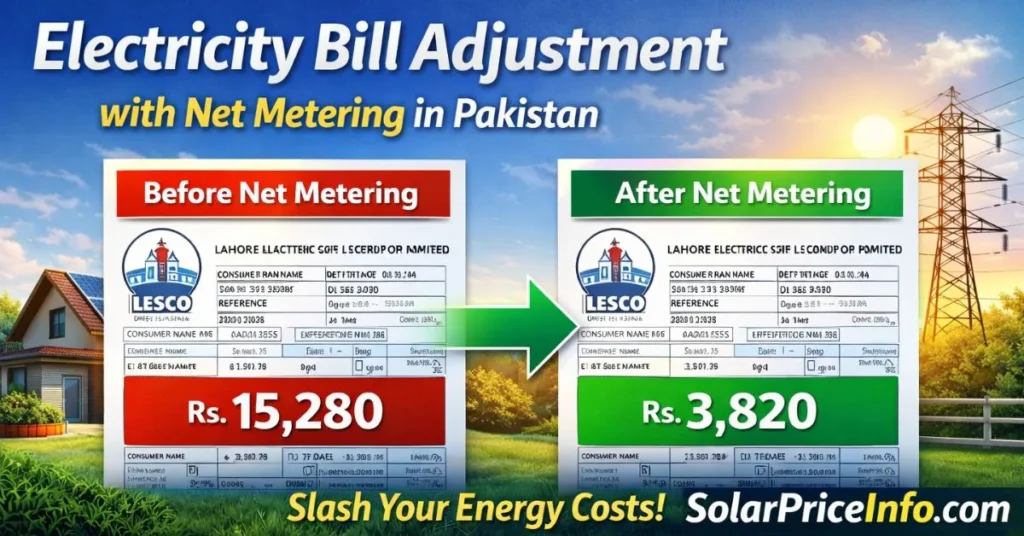
How Electricity Bill Adjustment Works (Simple Example)
- Imported units in a month: 500 units
- Exported units in a month: 350 units
- Net billable units: 150 units (+ fixed charges)
This explains why bills often drop significantly but may not reach zero due to fixed charges.
Common Problems & Rejection Reasons (And How to Avoid Them)
- Incomplete documents → Double-check submissions
- Non-compliant wiring → Follow utility safety standards
- Incorrect inverter configuration → Use approved settings
- Inspection delays → Track application politely and regularly
Some users also report delays with specific utilities (e.g., LESCO, IESCO, FESCO, MEPCO, K-Electric). These are operational issues—not rule changes—and are usually resolved with compliance and follow-ups.
Net Metering vs Other Solar Options
| Feature | Net Metering (On-Grid) | Off-Grid | Hybrid |
|---|---|---|---|
| Grid connection | Yes | No | Yes |
| Batteries required | No | Yes | Optional |
| Bill reduction | High | None | Medium |
| Export to grid | Yes | No | Sometimes |
Net metering is ideal for users with reliable grid access who want maximum bill reduction without battery costs.
Is Net Metering Worth It in Pakistan?
For most urban homes and businesses with daytime consumption, yes. It lowers monthly bills, improves energy independence, and shortens payback compared to off-grid setups—provided the system is designed and installed correctly.
Further Reading: solar system cost and savings in Pakistan
FAQs (Most Asked by Pakistani Users)
Final Verdict
Net metering in Pakistan is one of the most practical ways to cut electricity costs without investing in batteries. When installed correctly and aligned with utility standards, it delivers consistent savings and long-term value. For best results, plan your system carefully, follow compliance rules, and keep documentation complete.